RESTORATION SECTOR ALLIANCE
People • Planet • Prosperity
Table of contents
EXECUTIVE SUMMARY
Making the Invisible Visible
Across the state, ecological restoration is quietly powering a new sector of economy—one that provides family-sustaining jobs, protects communities, and restores the natural systems that keep every other industry functioning.
For decades, public debate has framed the economy and the environment as opposing forces: what helps one must harm the other. California's experience shows that the assumption is wrong.
Thousands of skilled workers now make their living rebuilding wetlands, forests, and floodplains; removing invasive species; stabilizing shorelines; and re-establishing habitat that supports clean air, water, and climate resilience.
This reflects both the growing scope of restoration science and an understanding of the multiple benefits these projects deliver. What began with efforts focused on single species expanded to whole habitats, and now to entire systems that explicitly include people. With that comes a surge in jobs and opportunities.
The truth is that ecological restoration is already a significant economic engine in California. Yet despite its scale, ecological restoration remains invisible—a blind spot, if you will—in official economic data. It is counted only in fragments: part construction, part environmental consulting, part conservation. As a result, its total value is hidden.
This report argues that ecological restoration already functions as a distinct economic sector and that formal recognition—through standard quantification systems such as the North American Industry Classification System (NAICS) and the occupational database O*NET—will unlock significant economic, environmental, and political benefits for California and potentially beyond.
For too long, seekers for careers in the trades who have an interest in the environment have not been presented with the opportunity to have a great environmental job by participating in construction of ecological restoration projects. Through these careers they can have vibrant lives, healthy environments, and do great work. They can take trade skills they already have and use them for something restorative.
It's time to take the next step of making these jobs visible, valued, and attractive—expanding the workforce needed to get critical work done.
A larger, better-supported workforce will, in turn, improve the quality of the work and speed at which it can be done, delivering important benefits to people and the environment on which we depend.
Recognition will:
Make restoration measurable. As the Bureau of Economic Analysis (BEA) did for outdoor recreation, recognizing restoration will highlight its contribution to jobs, wages, and taxes.
Make restoration investable. Institutional and impact investors often cite data transparency as a precondition for investing in new asset classes. Clear data will attract further infrastructure capital. This will be similar to what happened after data quantifying the outdoor recreation industry were made available: capital and policy attention followed.
Make restoration scalable. Taking the next step of making these jobs visible, valued, and attractive—especially to trade workers, where demand is highest—will expand the workforce needed to get the job done. A larger, better-supported workforce will, in turn, improve the quality of the work at the speed required for climate resiliency.
Five Steps to Formalizing the Sector:
There are enormous benefits of recognizing ecological restoration as a formal sector and counting its economic contribution in terms of job growth and more. There are five essential steps to getting that done:
1. Recognize restoration as a People-First Investment
2. Come Together as the Restoration Sector Alliance
3. Build Public Awareness and Political Support
4. Make Measurement Possible through Dedicated Industry and Occupation Codes
5. Elevate Trade Work within the Sector and Ensure that those doing this work have Access to Training
A Moment Made for California
California is uniquely positioned to lead this shift.
No state has done more to integrate environmental stewardship with economic innovation than California. From clean energy and electric vehicles to massive delta restoration projects and working to restore the use of cultural fire across our landscapes, California has repeatedly demonstrated that ecological leadership can drive prosperity.
Recognizing ecological restoration as a sector is the next logical step in that legacy. It is a chance to show the world that protecting nature is not a cost but a smart investment with measurable returns for workers, communities, and the natural environment we all depend on.
Introduction
Bringing the Ecological Workforce into the Light
Sometimes, good things wait patiently in the shadows until the time is right, and all we have to do is invite them into the light so they can benefit us all.
That is the goal of this report: to highlight the extraordinary and yet widely unseen contributions and potential of the ecological workforce in California.
But let us be clear. This is not simply a feel-good story, telling tales of people who restore riverbeds, wetlands, and more from decades of declining health of our ecological systems.
This is a story about power—good, needed, even essential power:
The power to create jobs,
The power to strengthen climate resilience, and
The power to grow the political clout of those who support a healthy environment.
In short, this report aims to:
Dispel the long-held belief that the economy and environmental stewardship are in opposition,
Reveal that, to the contrary, they are deeply connected, and
Above all, argue that those connections urgently deserve formal recognition as a sector of our economy so that California and places beyond can seize the economic, ecological, and political influence of what is already a sector in all but name.
Since the Ecological Workforce Initiative was founded, we have been honored to be in countless rooms where we have learned from our colleagues who are doing great work in climate and community resilience, nature-based solutions and infrastructure, ecosystem service projects, environmental mitigation, and stewardship, including: the California Landscape Stewardship Network, California Biodiversity Network, California Ecological Restoration Business Association, California Department of Natural Resources/University of California Berkeley, California Association of Local Conservation Corps, and California Jobs First.
We have also been honored to be on countless ecological restoration job sites, where we've learned from those doing the work. People like Frank, Debbie, and Eric whom you will meet in this report, are today's modern-day heroes. They are part of a growing effort that is similar to those of the 1950s and 1960s, when hundreds of thousands of prideful jobs were created by public investments in our interstate highways and water storage and conveyance systems.
We now have the opportunity to recognize that public and private investment restoring and stewarding our natural systems also leads to jobs, stimulates businesses, and restores confidence in the government and private capital's capacity to act boldly and for the common good.
A blind spot that needs to be illuminated.
Without coming together as a sector and advocating for proper accounting of activities that are restoring the natural systems we depend upon for survival, these projects, jobs, and other economic benefits are either claimed by other industries, or simply not considered.
That is the blind spot we have identified and believe needs to be illuminated. Making this blind spot visible is like coming upon a vast, recharging aquifer – one that can sustain and accelerate everything we need to do: ecologically, economically, and politically.
Case in Point
Consider California's 2024 climate and resilience bond, Proposition 4. This measure was primarily debated in terms of ecological outcomes—all, to be sure, important ones, including wildfire, drought, and flood resilience.
However, the $10B allocated by Proposition 4 is first and foremost an investment in people—the people who will carry out this essential work. Degraded fields and streams, wetlands and floodplains, shorelines and forests will be restored, but the money goes to people in the form of jobs, good, well-paying, meaningful, and enjoyable career jobs.
What is counted counts.
If there is one truism of our economy, it is this: in our economy, only what is counted counts. Measurable activities, in terms of dollars and cents—and, specifically, in terms of jobs created—are seen as mattering. Those that aren't counted fall by the wayside.
Only formal sectors—in which the activities of those engaged are measured and counted—are seen as:
Deserving of broad-based political attention,
Capable of attracting stable funding and lasting commitments, and
Worthy of support through education, apprenticeships, workforce programs, and more.
Establishing ecological restoration as a formal sector, in other words, provides a seat at the table alongside other established sectors such as healthcare and technology.
Why is this important, and why is it important now?
On the economic front, job creation clearly matters—and there are more jobs being created today in ecological restoration than in coal mining, timber harvesting, or in numerous other industries with a seat at the table. Yet the jobs created by ecological restoration funding are not recognized by the economic system as attributable to the policies and programs that create them in the first place.
On the environmental front, we all know that the need to build climate resilience is growing. We also know we are up against the clock, and the work is not happening fast enough to protect our communities, our infrastructure, and our natural systems, despite extensive efforts.
On the political front, as federal budgeting, policy, and other dynamics shift, there will be a growing trickle-down effect in California, with more competing demands being placed on state budgets. By measuring the economic impact of environmental restoration, stewardship and nature-based solutions, we empower people to recognize that ecological restoration drives job creation and economic growth and positions the Ecological Restoration sector to be more resilient in the face of changing political landscape.
Our Call to Action: Recognize ecological restoration as a formal sector.
Welcoming ecological restoration out of the shadows into the light can change all of this. Recognizing this work as a formal sector will create the legitimacy, policy, and funding needed to solidify its position as a significant economic engine and job creator, driving the economic, ecological, and political benefits we all need.
Many other sectors have seen the difference formal recognition can make, the outdoor industry being one of the recent ones. Once outdoor organizations came together as a sector and their activities were measured, there was an upsurge in investments, policy wins, and more.
Doing the same for ecological restoration will strengthen the benefits this work is already delivering to the world's fourth-largest economy. And, as has often been said, California leads the nation and the world—so the ramifications could be great indeed.
Our goal in offering this report is to inspire a conversation and, ultimately, the formation of a newly established Restoration Sector Alliance that leads to the establishment of ecological restoration as a formal sector. We hope you will join us!
part 1 — making the case
Measuring economic activity is how highly developed economies function, and in order to comprehensively measure the economic significance of ecological restoration, we must be recognized as a sector. We know the United States' gross domestic product (GDP) was $29.18 trillion in 2024. We don't guess it or suggest simply that it's big. The Bureau of Economic Analysis (BEA) measures it.
Similarly, we know that real estate and rental and leasing is the largest economic sector in the United States, followed by finance and insurance second, and health care and social assistance third. We know that manufacturing, retail trade, and construction are among the top 10 largest sectors because the BEA counts them.
On the federal level, political forces have veered away from protecting the natural environment. In large part this is occurring because of the assumption that economic and environmental interests are inherently in conflict—that environmental protection, investments in climate resilient infrastructure and restoration of ecosystems do not create economic growth.
This is not, of course, to say that people who highly value economic or business interests don't also value a healthy environment. Many, if not most, do, as evidenced in the widely held desire for clean water, air, and access to beautiful outdoor environments for everything from fishing and skiing to hiking and hunting.
"Businesses are invested in America's communities, and a clean, healthy environment is critical for quality of life and economic strength in every community."
US Chamber of Commerce
The rubber meets the road, however, when it comes to efforts to regulate or fund the protection and restoration of the environment, because those regulations are seen as at odds with economic interests.
By extension, environmental protections and, more generally, environmental stewardship work have gotten a bad rap. It has been seen as something that puts the interests of, say, an endangered frog above the interests of people.
The premise of this report is that nothing could be further from the truth.
Ecological restoration is a people-first investment.
Of course, restoration benefits species and landscapes, but its most immediate impact is creating good jobs. It revitalizes communities and sustains the natural systems on which our economies depend.
We ignore the primacy of benefits to people at our peril.
Amid shifting politics, we cannot presume that the generous economic support for restoration that has existed to date (through measures like California's 2024 Proposition 4) will continue. As the scope and scale of demands on state coffers expand, it could easily be vulnerable to reductions—unless voters and elected officials equate ecological restoration, stewardship of our land and waters, and climate resilient infrastructure with jobs, good, well-paying jobs held by people with a broad array of skillsets and at all levels of education.
And that can only happen, or at least be compelling enough, if ecological restoration is recognized for what it is: a growing sector that drives job growth and ecological and political benefits.
What Is Ecological Restoration?
Ecological restoration focuses on on-the-ground projects that return depleted ecosystems to a healthy, functional, and resilient state. Beyond its well established, inherent value for fish and wildlife, restoration work empowers communities — and as the practice has evolved, we've come to understand its fully overlapping benefits for people. We now know that proper ecosystem function and robust biodiversity critically benefit our activity by building resilience in natural systems and infrastructure that we depend upon.
Restoration activities are as varied as any sector and include:
Wetland and floodplain restoration to recharge aquifers and provide flood resilience
Sustainable forestry to advance old-growth characteristics, sequester carbon, and reduce fuel loads
Forest, grassland, and woodland restoration through indigenous fire stewardship to restore native species and reduce wildfire risk
Soil restoration and erosion control to improve soil health, stem topsoil loss and support food production
River and wetland restoration for recovery of culturally and commercially significant species like coho salmon
Native plant propagation to support ecosystem recovery and safeguard medicinal plant characteristics
Nature-based solutions in lieu of traditional infrastructure for long-term climate resilience
The Benefits of Recognition
Establishing ecological restoration as a sector will reveal its true significance—and create the legitimacy, policy, and funding needed for us to realize its potential, both economically and ecologically.
Until then, California will continue to undercount thousands of jobs, potentially underfund a proven climate solution, and limit its opportunity to attract the financial investment and trained workers who can make ecological restoration happen—if only because most people do not know that these opportunities even exist.
Recognition will enable us to show that the money for the restoration projects is going to people. And it will reveal that there are excellent opportunities in this work, regardless of level of education or socioeconomic status, that provide meaning and contribute to the common good.
More specifically, recognizing ecological restoration as a sector will:
1. Give restoration a seat at the table.
Policymakers structure laws, budgets, and oversight around recognized sectors, such as health care, agriculture, or tech. Unrecognized sectors are unseen, underfunded, and lack representation.
2. Give restoration work legitimacy, turning scattered jobs into real careers—and build the workforce infrastructure we need.
Restoration already employs tens if not hundreds of thousands: in project planning, construction, and long-term stewardship. Without a sector, many of these jobs are invisible, scattered across and claimed by other industries.
A formal sector will allow for standardized job classifications, career pathways, and certifications. Ecological restoration jobs will become recognized skilled labor classifications, attract new talent, and build professional pride.
It will also unlock apprenticeships, trade schools, and workforce programs, leading to strengthened skills, enhanced professional pride, and the attraction of much-needed new talent, including youth who may not otherwise have considered work in the environmental field.
3. Help secure stable funding and lasting investment.
Hard data creates confidence that attracts private capital. When investors and bond underwriters can see real returns from restoration, they can finance it. This directly results in restoration receiving sustained investment, not one-off grants.
All of this will also enable California, the fourth-largest economy in the world, to compile evidence demonstrating that economic health and ecological health are intrinsically interdependent—proof-testing a model that other economies could emulate.
Case Study: The Outdoor Industry Model
Once upon a time, the many people and businesses that powered recreation and other experiences in nature—from making the gear, apparel, and equipment to facilitating transportation and leading tours—were seen as part of a patchwork of activities in different sectors.
Coming together.
Then, those interests came together under the auspices of the Outdoor Industry of America (OIA), a 35-year-old association.
Being counted.
And equally importantly, they persuaded the US Bureau of Economic Analysis to measure their contributions.
Then US Commerce Secretary Wilbur Ross said: "Businesses need the right data to help them hire, invest and grow. The historical lack of detailed federal data regarding outdoor recreational activities has handicapped both the private and public sectors. The public will no doubt be surprised at the economic importance of this industry."
The Outdoor Industry, BEA found, represented 2 percent of US GDP ($373.7 billion in 2017) and supported 4.2 million jobs.
From there, numerous good things resulted:
The industry could track growth.
Hard data attracted further state and private investments.
Politicians recognized the significance of this constituency.
The bipartisan nature of the sector was seen as a benefit to both industry and rural development.
The sector successfully lobbied for policy wins.
Those are the kinds of opportunities that lie ahead for ecological restoration, which is similarly driving economic growth that advances both business and rural economic development.
Ecological Restoration at the Sector Threshold
Ecological restoration stands at the same threshold today.
For decades, restoration was viewed as a conservation expense—small, fragmented, and peripheral to "real" economic activity. But in California, where climate adaptation, wildfire recovery, and water security have become critical issues, restoration has matured into a full-scale industry.
It is providing good, well-paying jobs, strengthening community resilience, restoring ecosystems, and contributing to skillful new infrastructure improvements.
Ecological restoration already employs construction crews, engineers, biologists, equipment operators, nursery specialists, project managers, and many other professionals. It contracts with hundreds of firms, often pays prevailing wages, and generates tax revenue across multiple counties.
Moreover, public agencies, from Caltrans to the Department of Water Resources, rely on these contractors for projects that blend ecology and infrastructure.
This is all particularly significant in California. In 2024, California voters supported Proposition 4, which allocates $10 billion in general obligation bonds to fund climate resilience projects, including: safe drinking water; flood and drought resilience; wildfire and forest resilience; coastal protection; heat mitigation; biodiversity; working lands; and park and outdoor access.
In short, by every economic measure—employment base, output, tax generation, and growth rate—ecological restoration meets the criteria of a sector.
What it lacks is the recognition and, critically, a system for measuring it. Without that, restoration's contributions vanish into other categories. The result is a distorted economic record that undervalues a powerful engine of job growth in the state.
Sizing Up the Scale of Ecological Restoration
While ecological restoration jobs are not yet systemically measured—the critical blind spot we are arguing needs to be addressed—there are already strong indications of their significance.
A hint at its significance.
In the first significant study on the topic, the 2015 "Estimating the Size and Impact of the Ecological Restoration Economy," Todd K. BenDor, Director of the Odum Institute for Research in Social Science at the University of North Carolina at Chapel Hill, and colleagues, defined it as:
"Any combination of activities intended to result in ecological uplift, improve ecosystem health, and result in a functioning ecosystem that provides a suite of ecosystem services (i.e. the beneficial functions of ecological systems.)"
BenDor and his colleagues' national survey pointed to the industry's economic impacts and employment.
126,000
Workers directly employed
$9.5B
Workers directly employed
95,000+
Indirect jobs supported
$15b+
Additional economic output
How does this size up to other industries? Nationwide, ecological restoration jobs exceeded iron and steel mill jobs by some 35,000; exceeded coal mining by some 47,000 jobs; and exceeded logging by some 72,000 jobs.
Comparatively well-paying jobs.
Looking at income/output per worker as of 2021, the most recent BenDor study finds that the average salary in ecological restoration exceeds the average salary of those working in fields related to: construction of new highways and streets; environmental and other technical consulting services; construction of single-family residences; and construction of multifamily residences.
In fact, the average salary for wetland and stream mitigation jobs is $164,943, exceeding average salaries in many other fields, including construction of new highways and streets ($156,086), environmental and other technical consulting services ($140,169), construction of single-family residences ($119,132), and construction of multifamily residences ($89,197).
The bottom line.
While these academic surveys yield impressive glimpses into the scale of ecological recognition, they are still no substitute for the systematic counting of economic activity that comes with formal recognition of ecological restoration as a sector.
The Cost of Non-Recognition
Every year that ecological restoration remains statistically invisible, California leaves money, jobs, and resilience on the table, with the economic impact of these jobs categorized elsewhere and potential unrealized.
1. Misrepresentation
Because restoration work is often categorized under grey infrastructure construction, conventional landscaping, agriculture, and forest harvest activities, its economic value is credited elsewhere. Proper classification will reveal the sector's real contribution.
2. Fragmented Funding and Policy
Without a shared identity, restoration funding is almost entirely episodic, typically only providing discrete capital infusions through budget allocations, bond measures and investments by private and non-profit funders. Agencies and non-governmental organizations compete for project grants, primarily consisting of public 'one-off' funding, rather than collaborating on long-term programs. Communities experience stop-and-start employment cycles instead of steady work, and ongoing project stewardship is desperately underfunded.
Recognition will consolidate fragmented initiatives into a coherent sector strategy, aligning activities under a single economic banner.
3. Underdeveloped Workforce Pathways
Because restoration jobs are not tracked as part of a consolidated industry, workforce boards and education institutions have no data on demand or wage progression. Training programs remain localized, small-scale, and utilize inaccurate program classification to receive public funding for workforce development.
Formal recognition will justify state investment in apprenticeships and certifications, building a stable career pipeline.
4. Lost Opportunity for Private Investment
Investors seek measurable markets. Without sector data, restoration appears too uncertain for large-scale financing. Recognition will enable performance-based financing, public–private partnerships, and bonds backed by reliable metrics.
5. Slower Climate Adaptation
Interestingly, the cost of inaction is being thoroughly measured with every natural disaster in terms of flood damage, wildfire losses, and drought. Every delayed restoration project compounds future risk. This is something the insurance market has observed, making significant (and very real) investment in formal measurement of the economic impacts of climate disasters.
Recognition will accelerate project delivery and signal that California treats climate resilience as core economic policy, not discretionary spending. California could also become a leader in climate risk reduction and, therefore, lower insurance premiums, boosting economic activity.
Frank: Carrying on a Family Tradition
When Frank was a child, he paid attention when other men called his home to ask his father for advice. Frank’s father was a foreman with a civil construction contractor that specialized in ecological restoration and heavy civil construction in environmentally and culturally sensitive resource areas.
But what Frank remembers most of all is when his father brought him to job sites.
“It was back in the day when I was able to ride on a piece of equipment with him and actually see the scale of the work—what needed to be done or undone—and that was really exciting.”
So, when he graduated from high school, he followed in his father’s footsteps. And over the next 17 years, he has worked his way up, beginning as the guy who washed and sanitized the tools that would go on trucks headed to sensitive job sites, so they wouldn’t inadvertently introduce toxins, invasive seeds, and so on.
After three years, he was put in the field, where he learned a great deal about different plants and how they would, or would not, thrive in various ecosystems. He then began learning about heavy civil construction, learned to operate heavy equipment, was ultimately made a foreman, and had the opportunity to help run a multi-million-dollar project with his dad.
“I’ve been really privileged to see so many different places,” he said, adding that he and his crew recently completed a project in Yosemite National Park.
For Frank, however, an ecological restoration job is not just about the chance to work in beautiful places, learn a lot, or even make a difference by restoring areas that countless people enjoy and benefit from every day.
Ecological restoration, he says, is also a good job from a financial point of view. “This work is amazing,” he says, “and it pays very, very well.” He adds that, on his salary, he supports himself and his family.
In a full-circle moment, his daughter is now very excited to hear about his work and to see the places he has restored.
“Every time we go hiking, I point out the different species that we’re planting, and she’s like Wow! She’s really listening and thinks it’s cool. So, it’s not like we’re just walking; we’re learning as we walk through the forest.
“Then she goes to school and tells everybody what I do, but people don’t really understand it because it’s unfamiliar. So, one of the teachers was telling me I should come and present to the class, and I want to do that.”
In the meantime, Frank stays busy ensuring that everyone on his crew understands why they are doing what they do, so they not only benefit economically and help create ecological benefits but also can share in the knowledge of how important it is to balance benefits to people and the natural environment we all depend on.
part 2 — compounding benefits
The throughline of this report is that formally recognizing ecological restoration as a sector will lead to economic, ecological, and political benefits.
In Part One, Making the Case, we emphasized the significance of recognition as a sector because we see this as the most critical leverage point.
Now we briefly address the ecological, political, and economic benefits and provide a glimpse into new research emerging from an illustrative project on the North Coast of California.
Then we explore how these benefits compound and amplify each other once ecological restoration is seen for what it truly is: an important sector of the economy.
Ecological Benefits
Restoring degraded natural habitats provides a powerful array of benefits, including, but not limited to, cleaner water, climate mitigation and resilience, erosion prevention, disaster risk reduction from rising sea levels, and improved biological diversity.
Observing that we are presently in the U.N. Decade for Ecological Restoration (2020–2030), the United Nations Environment Programme emphasizes four large categories of ecological benefits:
Restoration helps reverse biodiversity loss and mitigate climate change. As they put it, ecosystem restoration is a natural climate solution.
Restoring degraded ecosystems can support local and global economies. Marine and coastal ecosystems are estimated to generate benefits for people and nature valued at USD $47 trillion, according to the U.N.
Restoration of degraded landscapes boost ecosystem services, contributing to alleviating poverty and supporting rural economies.
Restoration can help address water scarcity. Two-thirds of the world's population already experience water scarcity.
Restoring land "has the potential to raise groundwater levels, and healthy soils can store more nutrients and produce higher quality plants, improving food production and reducing agriculture pressure on natural systems."
Healthy ecosystems support healthy people. The risk of diseases that can be transmitted between animals and humans (zoonotic diseases) increases when ecosystems are degraded.
Savvy to benefits such as these, California has made significant commitments to ecological restoration.
For example, in 2019, California Natural Resources Agency launched an initiative to improve permitting and funding efficiency to accelerate the pace and scale of restoration projects through a measure known as Cutting Green Tape.
In 2020, Gov. Gavin Newsom signed an Executive Order implementing a 30x30 strategy—designed to conserve 30 percent of the state's lands and coastal waters by 2030.
And, in November 2024, California voters overwhelmingly approved Proposition 4, a $10 billion Climate Bond designed to safeguard our communities, natural resources, and our future. (As we mentioned above, Proposition 4 also delivered exceptional job growth, although this tremendous benefit was caught up in a collective blind spot.)
The question for California, then, is not whether we recognize the ecological benefits of ecological restoration, but whether we recognize the political and economic ones, so that the vital support for resilient natural systems continues.
A Restoration Project That Solved Three Problems at Once
The town of Pescadero is a small rural farming and ranching community in northern California, a little over a mile from the coast. True to its name, which means "fishing place" in Spanish, Pescadero is also home to Pescadero Creek and Butano Creek, both known for their historic runs of wild steelhead and coho salmon.
As logging and demand for roads, farmland, and other development increased, so did the amount of sediment coming off the surrounding hillsides. The flat valley sections of both of these creeks were also gradually straightened and channelized, leading to unnatural sediment accumulations.
This problem was particularly profound in Butano Creek, and the excess sediment filled the channel and caused chronic flooding of the only route in and out of town—hindering emergency access and residents' ability to get to work, drive their children to school, etc. This excess sediment in Butano Creek also blocked the coho salmon and steelhead from accessing much of their natural habitat in nearly 90% of the watershed. The sediment accumulations also led to water quality issues downstream in the Pescadero Marsh Natural Preserve, where low-oxygen water resulted in annual die-offs of fish in the marsh.
The San Mateo Resource Conservation District worked with a variety of partners over many years to find solutions to these problems, engaging engineers, scientists, community members, and representatives from several different agencies.
After extensive outreach and technical work, the community, landowners, and natural resource agencies agreed upon an approach that would tackle flood reduction, fish passage, and improved water quality. In 2017, the RCD was awarded funding from local, state and federal sources for the Butano Creek Reconnection Project. Ecological laborers and equipment operators were hired to excavate, dredge, and construct the various elements of the project. The successful construction resulted in:
Re-established connectivity between the upper and lower watershed via dredging and excavating 8,000 feet of the historic creek channel,
Removal of 45,000 cubic yards of sediment from the creek channel, and
Re-use of the dredge material to fill historic human-made drainage channels in the marsh, restoring 28 acres of degraded coastal marsh.
Within two years, the work was done, and the creek and marsh have grown healthier every year. The creek now runs free, migration has been restored for native salmon and trout, and the risk of flooding along the roadway has been significantly reduced. This is just one of many examples of the multiple wins that restoration can provide: to the economy, ecology, and communities.
Political Benefits
Recognizing ecological restoration as a formal sector has the potential to deliver substantial political benefits by transforming it from a niche environmental concern, often seen as optional and politically divisive, into a visible driver of jobs, economic vitality, and community renewal.
When restoration is seen as a sector, it gives political leaders a powerful story to tell about creating good jobs, strengthening local economies, and delivering on climate resilience commitments.
Today, workers may be unaware that their jobs and wages come directly from restoration projects funded by propositions they may have voted against. Industry trade organizations may be lobbying against policies that actually provide significant financial benefits to their member companies. By highlighting the jobs, funding, and community benefits, we can help connect the dots and build a broader constituency that supports this work.
Framing it as a sector allows elected officials to highlight these visible, place-based outcomes as evidence of effective policy and responsible stewardship, turning environmental progress into a bipartisan win.
Formal recognition also strengthens political coalitions by broadening who sees themselves as part of the environmental movement. When restoration workers, contractors, and community partners understand that their livelihoods depend on ecological investment, they become a natural constituency for sustaining and expanding it.
Importantly, this work bridges the divides between labor and environment, rural and urban communities, and across party lines. In an era marked by polarization, formal recognition of restoration as a sector offers a rare unifying platform.
Economic Benefits
As noted above, our ability to estimate the economic benefits of ecological restoration is seriously limited because government data collection distributes these activities to other legacy industries, such as traditional grey infrastructure construction, civil engineering, conventional landscaping, and other resource harvesting categories.
That is why we are arguing for formal recognition of ecological restoration and the counting of the breadth of its economic activities that will allow.
Prof. BenDor's surveys provide one limited glimpse—a welcome teaser if you will.
Here is another: In 2025, Parks California, the North Coast Redwoods District of California State Parks, the Ecological Workforce Initiative, and the Bank of Montreal (BMO) partnered to conduct an economic analysis of a sample dataset of restoration projects scheduled in the next five years in Del Norte and Humboldt Counties.
A significant economic driver.
BMO's working conclusion is this: "Based on our research, when the projects are aggregated, it becomes clear that ecological restoration is a significant economic driver throughout the North Coast, providing financial opportunity for the workers and socioeconomic benefits for our communities at large."
Job growth.
More specifically, they note that, if the jobs constructing Humboldt and Del Norte County projects are filled by Humboldt and Del Norte county residents, over the next 5 years restoration projects could lead to:
$87m
Construction wages into two counties
1,030
Trade work positions
$235m
Direct economic impact
$410m
Additional economic output
Significantly, as BMO notes, these results are from the preliminary analysis of a limited data set.
Above-average wages.
The impact of these ecological restoration projects is important because these are skilled trade-work jobs that do not require a college degree and provide above the per capita income for both counties, using the project wages range of $42,000 to $108,000 per year, per season.
Again, this is just one example of a much larger set of activities. But we hope its significance underscores the importance of formal recognition of ecological restoration so that its accurate contributions can be measured and potential reached.
Putting It All Together
Clearly, these economic, ecological, and political benefits are not separate outcomes—they are mutually reinforcing.
When ecological restoration is recognized as a formal sector, its economic visibility strengthens political will, which in turn secures the long-term investment needed to achieve large-scale ecological gains.
The ecological gains then generate further economic opportunity through reduced disaster costs, improved water and soil systems, and healthier communities—all of which enhance public trust and political capital.
The feedback loop is powerful: each dimension of benefit amplifies the others, creating a cycle of renewal that mirrors the regenerative nature of restoration itself.
This compounding effect also helps California model a new kind of prosperity. This is rooted in enduring resilience and shared well-being, stabilization of local economies, growth of bipartisan support, and the acceleration of projects essential to climate adaptation and resiliency.
In short, by naming and counting restoration as a sector, California can again reach its potential to lead the way in regenerating ecosystems, revitalizing communities, and renewing confidence in collective action toward a sustainable future.
Debbie: From Fitness Instructor to Restoration Professional
Debbie always loved being outside and gardening, but she never knew someone could make a career out of it beyond working on private property. So, she became a fitness instructor instead—until the club she worked for closed down.
Her husband, who worked on the civil construction side of a restoration organization, then mentioned that the company had a large, local planting job coming up, and she submitted her application.
In Debbie's first year, she worked with a large crew that planted more than 800,000 plants in Mendocino County, California.
"I just got a kind of crash course in this kind of field, and I loved it," she says. "It's hard work, but it's fun. I met some really nice people. I get to work in a beautiful area. I like being outside. And the work is quite rewarding."
Working her way up as a supervisor, Debbie also appreciates the learning involved in her job, saying that she has been part of several projects that have involved testing and experimentation that worked.
While she is still one of only a relatively few women doing work like this, Debbie says, "I think a lot of women would really quite enjoy ecological restoration work—especially if they enjoy nature and want to be outside and not be a computer warrior."
"I always feel, especially during the planting season," she adds, "that we're giving back to the Earth." But it's not only rewarding from a contribution perspective, she says. She is also now making more money than she ever has in any other job.
"To see the elk thriving in our area and the insects thriving in our area—I've seen more dragonflies than ever this year—and it's just like, 'Oh, so happy to see you.'"
part 3 — Five Steps to Get It Done
Given the enormous benefits of recognizing ecological restoration as a formal sector and counting its economic contribution in terms of job growth and more, the question now is: How do we get it done? This section identifies five essential steps.
STep 1 — Recognize Restoration as a People-First Investment
While restoration naturally benefits species and ecosystems, its most immediate impact is creating good jobs.
In California, it is estimated that, after the cost of land acquisition, 70 percent of all ecological restoration capital project funding goes to construction contractors, and up to 40 percent of that goes directly to construction workers.
Restoration also revitalizes communities and sustains the natural systems on which our economies depend.
STEP 2 — Come Together as the Restoration Sector Alliance
The Ecological Workforce Initiative will invite key allies and interested organizations to come together for an inaugural convening of the Restoration Sector Alliance.
This gathering will be intended to help us, first, recognize that Together, We Are a Sector and, second, to initiate the steps needed to make that formal recognition a reality.
This is, among other things, inspired by a recent report that explores how important the collaborative approach to complex problems is. (Mickel, A. E., & Farrell, S. D. (2025). Do more, better, together: Investing in collaborative work to make a difference. (California Landscape Stewardship Network – Do More Better Together)
Step 3 — Build Public Awareness and Political Support
Launch a communications initiative—modeled on the Outdoor Industry Association's 2017 campaign—to highlight restoration's economic impact and community benefits. Share stories of workers like Frank, Debbie, and Eric to humanize the sector and attract new talent.
Step 4 – Make Measurement Possible Through Dedicated Industry and Occupation Codes
Ensure formal industry and job classifications through the North American Industry Classification System (NAICS) and O*NET. These are the standard methods used by Federal statistical agencies in classifying business establishments and job data for the purpose of collecting, analyzing, and publishing statistical data related to the US business economy.
Distinct codes will enable accurate tracking rather than have ecological restoration activities subsumed by other sectors, such as construction and engineering.
step 5 – Elevate Trade Work within the Restoration Sector
Construction workers are the largest, least recognized, and most socioeconomically diverse component of the workforce involved in ecological restoration.
Acknowledging and championing the efforts of this workforce will significantly expand the representation of people who support healthy ecosystems, and will elevate the status of trade jobs in general, which is a goal shared by people across the political spectrum.
Through training, we can expand marketable specialties and ensure a consistently high level of skill on the project sites.
Finally, it will reveal restoration workers as modern-day heroes. Their work brings salmon back to people's tables, reduces flooding risks to basements and communities, returns fresh drinking water to people's faucets, and helps build resiliency against the many everyday risks of climate change.
Eric: Teaching Young People Why Ecological Restoration Matters
Not everyone can say that their job is "the best thing ever." But to Eric, having an ecological restoration job is just because he gets to work outdoors, see beautiful places, do meaningful work, and get paid well.
A 30-something father of three, he remembers when he first learned that it was possible to get a job like this—and that trade jobs were not limited to working as a mechanic, in video, or in culinary arts, as it seemed when he was in high school.
"I was like, 'Holy cow, you're working in creeks using dozers and planting new plants and building new channels? This is awesome.'"
Today, he plays a vital role in training young people, using his bilingual skills to reach young Spanish-speaking employees. It's a role that, in the beginning, was a big stretch for Eric, who felt he wasn't good at speaking.
"But I started seeing the employees, the younger kids, and I was like, 'Wow, these young people. They're the future. And this work is about making a change for them.'"
What excites him now is helping them understand why ecological restoration matters—both as a good, well-paying job and as a way to give them a strong sense of purpose.
Sometimes, he says, that purpose also becomes quite personal for people. One young man, for example, said in the beginning that all he cared about was fishing. Eric then helped him understand why specific fishing laws and regulations existed—to protect the fish.
"Imagine," he recalls explaining, "if we kill all these fish and don't restore the land or build new channels for them. You won't have anywhere to go to fish."
He said, "Oh, I never thought about it like that."
Eric says he has also seen the work itself have a profound impact on some of the people who do it. One time, he recalls, one young woman shared that when she started working in ecological restoration, she was experiencing some severe depression. But working outside in beautiful places, she shared, healed her on the inside.
In the end, he says, "Everybody cares about getting paid and how much they're being paid. But once they see the other side of it—that they are helping the environment and maybe even healing themselves—then they feel like, 'Wow, I love my job. But now I care about it even more.'"
Conclusion and Invitation
Ecological restoration is no longer a niche environmental activity. It is a full-scale industry building the foundation of California's economy. It creates good jobs, safeguards communities, and protects the natural assets that make every other sector of economic activity possible.
Recognition will:
Give California's restoration firms and workers the legitimacy they deserve.
Enable quantification of the job creation and economic impact of public investments in environmental restoration, stewardship, and nature-based solutions.
Demonstrate to investors that restoration is a stable, high-return asset class.
Allow policymakers to manage resilience as an integral part of economic growth.
By leading this effort, California can show that economic strength and ecological health are not competing interests but two sides of the same prosperity. In doing so, the state will help define the economy of the future, one that restores as it grows.
Our goal in offering this report is to spark a conversation and ultimately a collaborative movement that highlights this sector's scale, scope, and myriad benefits by measuring and thereby strengthening its impact.
By doing so, the ecological restoration sector can claim the economic, ecological, and political clout it has earned; help reshape the conversation; and shatter the myth that we must choose between a healthy economy and a healthy environment.
We invite you to join us in this effort by working toward the recommendations above and joining us to:
Adopt shared language. Use the term Ecological Restoration Sector in agency documents, contracts, and funding proposals.
Share this report. Circulate it among policymakers, funders, and industry peers.
Join the conversation. Participate in the inaugural Restoration Sector Alliance convening to shape standards and build a coalition for recognition. Reach out to us at alliance@ecologicalworkforce.org
California has the projects, the people, and the precedent to lead the world in building an economy that supports people, communities, and the environment—and helps bridge partisan divides by recognizing the true diversity of those engaged in this vital work.
The moment to recognize the sector and measure this work is now.
California has the opportunity to lead—collaboratively and with vision. Whether you are a policymaker, environmental leader, restoration practitioner, investor, contractor, workforce member, educator, or someone who simply believes that a healthy economy and a healthy environment go hand in hand, there is a place for you in this effort.
Share this report. Use the term Ecological Restoration Sector in your work. And join us in building the collaborative effort that will make formal recognition a reality.
To get involved, learn more, or participate in the inaugural Restoration Sector Alliance convening, reach out—we'd love to hear from you.
About the Ecological Workforce Initiative and Team
The Ecological Workforce Initiative (EWI) is a nonprofit organization working to bring respect and recognition to the laborers and equipment operators and others who do the physical work of ecological restoration projects. EWI sits at the intersection of two of the most pressing needs of our time: building climate resilience and creating attainable pathways to respected, living-wage jobs. We believe it's possible to improve ecological health while enabling people to thrive economically.
We are bringing together people and organizations across the ecological restoration spectrum—from policymakers and agencies to project proponents and restoration professionals, to contractors and employers, to the workers in all roles. Our goal is to recognize ourselves as a sector of our economy.
Because we focus on the workers, we have been invited to partner with several environmental organizations, networks, and associations across the state who are committed to workforce development. What we found is that each of these strong, dedicated efforts is part of a larger, unrecognized whole. In short, we became convinced of the need to bring the disparate, but aligned, efforts into dialogue.
This paper is our contribution to a broader conversation—one that brings us together as a community with shared goals of uplifting the health of our environment while also strengthening the economic health of our communities, so that both can thrive. To recognize ourselves as a Sector and a powerful economic driver. To communicate the truth that investing in ecological restoration and nature-based solutions is not just about "bugs and bunnies"; it is about jobs and the people who fill them. For too long, we have thought that we had to choose between the health of the planet and the health of the economy. When we recognize the full spectrum of restoration work and create pathways accessible to all, we can heal that divide.
While we think our Ecological Worker Awareness and Compliance Training can play a positive role by building a skilled workforce, this paper is not motivated by organizational self-interest; rather, it is meant to advance collaboration. We want to unite all working for ecosystems, celebrate the restoration sector's economic and ecological contributions, and move forward together.
The ewi team

Sally Bolger, Executive Director
Sally Bolger is an electric vehicle technology entrepreneur, nonprofit executive director, restoration project manager, and charitable giving advisor. She brings her career-long focus on implementing cutting-edge environmental solutions to lead the Initiative. She nurtures the partnerships, develops the programs, and establishes a strong organizational foundation to implement the high-level change for which we are aiming.
My commitment to the Ecological Workforce Initiative stems from my firsthand experience with the difference a trained crew can make. As project manager for the Giacomini Wetlands Project, at the time the largest coastal wetland project in CA, I saw the stark difference between crews with and without ecological training.
In the first season, the crew lacked understanding of the project's ecological goals and permit constraints. That season was filled with many worry-filled and sleepless nights.
In the second season, we hired a different company with ecologically trained workers. The experience was completely transformed. The crew members quickly became trusted teammates, helping inform on-site decisions, protect sensitive species, and suggest ways to improve project success.
That experience deepened my respect for the skilled workforce environmental projects need. So, when Mark proposed developing specialized training for ecological workers, I jumped at the chance. In the years between the Giacomini Project and EWI, I worked internationally at the intersection of conservation and community. This was an opportunity to do the same in my own beloved California—connecting people to the land through meaningful, well-paying careers caring for it.
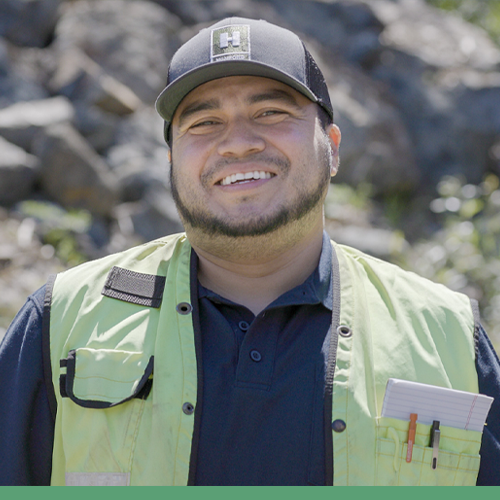
Eric Buenrostro, Program Director
Throughout his career as an ecological restoration construction worker, safety coordinator, and bilingual/bicultural educator, Eric has honed his extraordinary talent for connecting people of all ages and backgrounds to the environment and has strengthened his dedication to creating opportunities for life-sustaining and fulfilling careers. Eric's breadth of professional experience and personal commitment to the communities we serve help enhance EWI's relevancy, accessibility, and educational effectiveness for all.
I had never heard of the Ecological Workforce until a couple of years ago, and probably a lot of you haven't either.
Back when I was in school, the only thing they taught us we could have a career in was being a Doctor, Firefighter, Lawyer, Mechanic, Cinematographer, or Chef. How would I have known about working in the Ecological Workforce? But what if there was a career in it? A job where you get paid well, get to be outdoors in beautiful areas that you've probably never heard of, and restore the land.
I was lucky enough to get a job working for a construction company for 10 years, where I learned the basics at first. Digging a trench to put up a silt fence to keep sediment from rolling into the creek, digging a 3-5 inch trench, and placing what looks like a big, long anaconda snake, but it's a wattle. I got to see so many beautiful areas in California that we restored from all the way up North in Fortuna to all the way down South in the Mojave Desert of Barstow, and in between, like Muir Woods National Park. As the years went by, I built my skills and learned to grade-check and run some jobs, and at the very end of my time there, I was the safety officer.
Then I got the chance to meet Sally with the Ecological Workforce Initiative, learn what they were about and the goal they had in mind, and I was all in on helping them! This really opened my eyes to realizing that all those years back, when I was working for the construction company, I was an Ecological Worker the whole time!
That is why I care about what I am doing now. Knowing ecological restoration projects are going on right now, letting the workers know the "Why" they are there, what's the purpose of them doing what they are doing, both in English and Spanish. Being inclusive with all employees and connecting the dots is the most important thing. It builds that connection among laborers, foremen and superintendents, biologists, and other members of the project, who share the same goal.

Mark Cederborg, Policy Director
Mark is a former CEO of a civil construction firm specializing in ecological restoration, and a restoration-construction professional with 30 years of field experience advocating for workforce recognition and industry standards. Throughout his career, Mark has witnessed the need for industry-wide standards for restoration workers. He brings his vision and insight to catalyze the partnerships and resources needed to create a recognized and respected identity for the ecological trade workers who implement environmental projects.
In high school, I dreamt of a career restoring the natural world, working with my hands. At the time, however, high school career counselors told us that the way to get into restoration was to go to college in the sciences and never suggested trade work as an option. Fortunately for me, I had the resources to go to college.
But, at 23, I still longed to work outdoors. I faxed my resume for a $10/hour job as an environmental landscaper, having no idea what was in store for me as a laborer. Over the next 10 years, I was surprised at the level of disrespect by college-educated peers who dismissed me as "just a laborer." I saw others treated that way, too, despite their good suggestions about how to do things more efficiently or effectively, based on the intimate knowledge they gained working directly with the resources they were restoring.
It became my passion to translate between science and the trades for the benefit of both. It worked, and for the next 25 years, the company I worked with was seen as the leader in ecological restoration construction. Crews showed the ability to receive and accept knowledge and the willingness to work towards a common goal.
It became clear what a difference advanced knowledge could make. A truly reasonable amount of effort by a small business was all it took to train crews in ecological concepts and environmental regulation compliance. That's when the magic began, and with Executive Director Sally Bolger, the Ecological Workforce Initiative was formed.

Jim Robins, Curriculum Developer and Trainer
As a respected water resource and regulatory compliance expert, restoration practitioner, and educator, Jim has the unique perspective of one involved in the complete life cycle of restoration projects—from inception through implementation. Jim brings his ability to see how well-crafted ecological training and an educated workforce can positively impact project outcomes and facilitate successful implementation of the State’s Cutting Green Tape Initiative.
I was a teacher before I was an ecologist, and a person who loved the outdoors before I was a teacher. I moved to California in 1993 as a naturalist at Camp Jones Gulch, where my job was to infect 5th and 6th graders with awe, wonder, and curiosity about the natural world. As it turns out, I inspired myself, and have spent 30 years absorbing knowledge like a sponge from the people and ecosystems I’ve had the pleasure to live and work in.
My formal ecological education came through a master’s in Rangeland Management, grounding me in the deep understanding of the role people play in stewarding the ecosystems that we and all the critters around us rely on for food, water, clean air, and temperature moderation. People have always been central to how I understand ecology.
As a restoration practitioner for much of the past two decades, nearly all of my work has focused on the intersection of people and environment—understanding past land-use decisions and their ripple effects; working with public agencies and private landowners to understand their goals and mandates; finding common ground to solve seemingly intractable resource issues. Regardless of ecosystem or landowner, people are the key drivers of change.
Working with construction workers on restoration projects has reinforced my belief that the larger the community working together, the greater the potential for meaningful change. I’ve learned enormously from excavator operators, laborers, and other workers—their understanding of the work, their ideas for improving outcomes, and their frustration at not having a seat at the table. Engaging with and learning from trades people has been one of the most fulfilling parts of my career, and I look forward to continuing that through my work with EWI.