
Ecological Restoration Is Redefining the Relationship Between the Economy and the Environment
Making the Ecological Restoration Sector Visible
Across California, ecological restoration is quietly powering a new sector of the economy—one that provides family-sustaining jobs, protects communities, and restores the natural systems that keep every other industry functioning. For decades, public debate has framed the economy and the environment as opposing forces. This report argues that assumption is wrong, and that formal recognition of ecological restoration as an economic sector will unlock profound benefits for workers, communities, investors, and the natural world.
Ecological restoration is already a significant economic engine in California. Skilled workers rebuild wetlands, forests, and floodplains; remove invasive species; stabilize shorelines; and re-establish habitat that supports clean air, water, and climate resilience. Yet despite its scale, ecological restoration remains largely invisible in official economic data—counted only in fragments, as part construction, part environmental consulting, part conservation. As a result, its total value is hidden. But two studies point to it:
2015 National Study
126,000
Workers Directly Employed
9.5b
Annual Economic Output
95,000+
Indirect Jobs Supported
$15b+
Additional Economic Output
A 2015 national study estimated that ecological restoration directly employed 126,000 workers, generated $9.5 billion in annual economic output, and supported more than 95,000 additional indirect jobs. Nationwide, ecological restoration employment exceeded iron and steel mill jobs by 35,000, coal mining jobs by 47,000, and logging jobs by 72,000. The average salary in wetland and stream mitigation work was $164,943—higher than average salaries in highway construction, environmental consulting, and residential construction.
Humboldt and Del Norte Counties
$87m
Construction Wages
1,030
Trade Work Positions
$235m
Direct Economic Impact
$410m
Indirect Economic Impact
More recently, a 2025 economic analysis of restoration projects scheduled over five years in just two Northern California counties—Del Norte and Humboldt—projected $87 million in construction wages, 1,030 trade work positions, $235 million in direct economic impact, and $410 million in indirect economic impact. These are skilled, above-average-wage jobs that do not require a college degree.
What Is Ecological Restoration?
Ecological restoration is about returning depleted ecosystems to a healthy, functional, and resilient state. Beyond benefitting fish and wildlife, restoration work empowers communities. Activities are as varied as in any sector, including:
Wetland and floodplain restoration to recharge aquifers and provide flood resilience
Sustainable forestry for carbon sequestration and to reduce fuel loads
River and wetland restoration for recovery of culturally and commercially significant species recovery
Soil restoration and erosion control to improve soil health, stem topsoil loss and support food production
Nature-based solutions for infrastructure for long-term climate resilience
Forest, grassland, and woodland restoration through indigenous fire stewardship to restore native species and reduce wildfire risk.
A People-First Investment
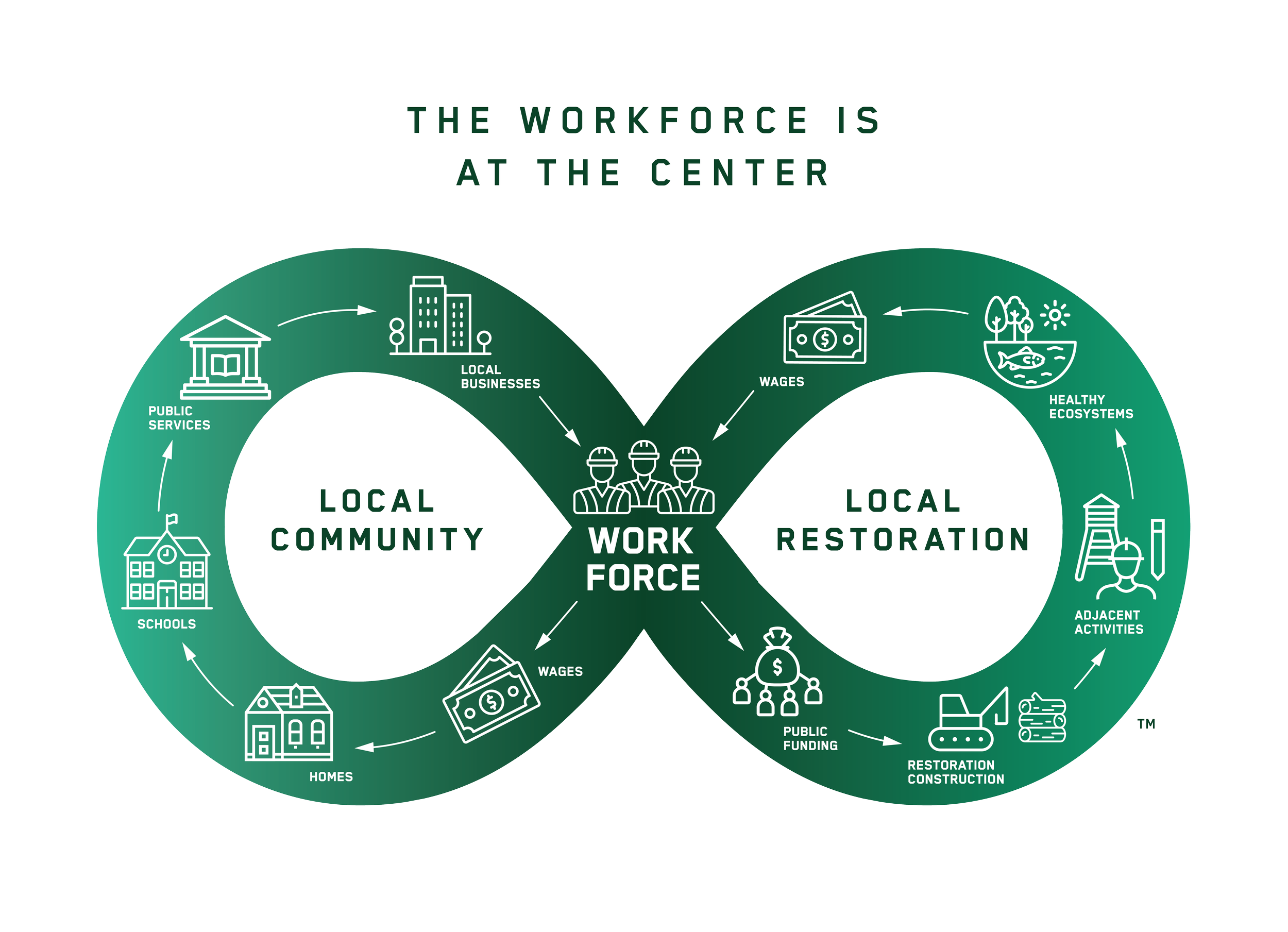
While restoration clearly benefits species and landscapes, its most immediate impact is creating good jobs. In California, it is estimated that after land acquisition costs, 70 percent of all ecological restoration capital project funding goes to construction contractors, and up to 40 percent of that goes directly to construction workers. These are jobs for the workers on the ground, the equipment operators, laborers and other trade workers who take the years of planning, design, and permitting and create the finished project.
These are today’s modern-day heroes—and they deserve to be seen, counted, and celebrated. People like Frank, who followed his father into the field and now leads multi-million-dollar projects in places like Yosemite National Park, supporting his family on a restoration salary. And Debbie, who transitioned from fitness instruction to planting more than 800,000 plants in Mendocino County and now earns more than she ever has. And Eric, a bilingual trainer who helps young workers understand not only the craft but the purpose behind their work.
The Cost of Non-Recognition
Every year that ecological restoration remains statistically invisible, California leaves money, jobs, and resilience on the table. Because restoration work is often categorized under grey infrastructure construction, conventional landscaping, and agriculture, its economic value is credited elsewhere. Without shared identity, funding is almost entirely episodic—communities experience stop-and-start employment cycles instead of steady work, and ongoing stewardship is desperately underfunded. Without sector data, policymakers see no relevancy to their constituencies, workforce boards have no information on demand or wage progression, education and training institutions have no funding for these programs, and investors see no measurable market to finance.
Delayed restoration also compounds future climate risk. Every season without action means more flood damage, greater wildfire losses, and worsening drought. Recognition will accelerate project delivery and signal that California treats climate resilience as core economic policy, not discretionary spending.
The Compounding Benefits of Recognition
Formal recognition will deliver compounding ecological, political, and economic benefits that reinforce one another.
Ecologically - restored wetlands and forests provide cleaner water, climate mitigation and resilience, reduced disaster risk, and improved biodiversity.
Politically - when restoration is seen as a sector, it gives leaders a powerful story about creating good jobs and strengthening local economies—one that bridges the divides between labor and environment, urban and rural communities, and across party lines.
Economically - hard data creates investor confidence, attracts private capital, and enables performance-based financing and public-private partnerships.
The Outdoor Industry Association offers a clear precedent. When outdoor recreation organizations came together and persuaded the U.S. Bureau of Economic Analysis to measure their contributions, they found the industry represented 2 percent of U.S. GDP and supported 4.2 million jobs. Capital and policy attention followed. That same opportunity now lies before ecological restoration.
Five Steps to Getting It Done
The Ecological Workforce Initiative calls for five essential steps to formalize the sector:
Recognize Restoration as a People-First Investment — frame ecological restoration policy and funding around job creation and community benefit.
Come Together as the Restoration Sector Alliance — convene key allies and organizations to formally recognize that, together, we are a sector.
Build Public Awareness and Political Support — launch a communications initiative modeled on the Outdoor Industry Association’s 2017 campaign to highlight restoration’s economic impact and human stories.
Make Measurement Possible Through Dedicated Industry and Occupation Codes — secure formal classifications through NAICS and O*NET, so restoration is tracked accurately rather than absorbed into other sectors.
Elevate Trade Work Within the Restoration Sector — champion the construction workers who are the largest and least recognized component of the restoration workforce, expand training and apprenticeships, and reveal restoration workers as the modern-day heroes they are.
A Moment Made for California
California is uniquely positioned to lead this shift. No state has done more to integrate environmental stewardship with economic innovation. From clean energy and electric vehicles to the 2024 Proposition 4 climate bond—which allocates $10 billion for climate resilience projects—California has repeatedly demonstrated that ecological leadership can drive prosperity. Recognizing ecological restoration as a sector is the next logical step in that legacy.
Formal recognition will make restoration measurable—revealing its contribution to jobs, wages, and taxes the way the Bureau of Economic Analysis did for outdoor recreation. It will make restoration investable—attracting institutional and impact capital that currently has no clear data on which to act. And it will make restoration scalable — expanding the workforce with the visibility and career pathways needed to meet the pace and scale that climate resilience demands.
Ecological restoration already functions as a distinct economic sector. What it lacks is formal recognition—and the counting that comes with it. By naming this sector and measuring its contributions, California can shatter the myth that we must choose between a healthy economy and a healthy environment. In fact, they are two sides of the same prosperity.
Join the Restoration Sector Alliance
People • Planet • Prosperity
Whether you are a policymaker, environmental leader, restoration practitioner, investor, contractor, workforce member, educator, or someone who simply believes that a healthy economy and a healthy environment go hand in hand, there is a place for you in this effort. Adopt the term Ecological Restoration Sector in your work. Share this report.
Read the full report and to join us in building the collaborative effort that will make formal recognition a reality.
Contact: alliance@ecologicalworkforce.org